
Geographically, Cottingham and Middleton are located in the county of Northamptonshire, although they have a Market Harborough, Leicestershire postcode (LE16).
The spelling of Cottingham has varied throughout history. We find references to Cotingeham in the Domesday Book and Cotingham in the Anglo Saxon Chronicle (see timeline below, 1197). In the 1162 and 1166 Pipe Rolls there are references to Cottingeham and, in the 1343 Inquisitiones Post Mortem, Cotyngham and Cotynham.
Middleton was not around at the time of the Domesday survey, but can be traced back at least to 1197 when the village appeared in a feet of fines. In this context, fines (or final concords) were records of land transfer. In 1560, we find a reference to ‘The vill of Cottingham and Middleton, which is a hamlet of the same vill’ and the 1861 Census also refers to Middleton as a Hamlet. The 1841 Census refers to ‘The civil parish of Cottingham with the Township of Middleton’.
From at least 1066 until around 1841, the country’s parishes were split into administrative districts called Hundreds. In 1086, Cottingham lay within the Stoke Hundred, which was merged into the Corby Hundred in 1196. The 1841 Census was the last to group parishes by Hundreds, but reference to Cottingham being in the Corby Hundred can be found as late as the 1914 Kelly’s Directory.
Key facts and figures
- From 954 to 1541, Cottingham was owned by Peterborough Abbey (the Abbey of Burgh).
- After the dissolution of the monasteries in 1536, the village reverted to the Crown, and Henry VIII passed it to Katherine Parr’s father, William Parr. When Parr’s nephew forfeited the family’s lands (for supporting Lady Jane Grey’s claim to the throne), Cottingham went to Elizabeth I, who granted it in fee to Sir Christopher Hatton. In 1777, the Hattons sold the ‘living’ of Cottingham to Brasenose College, Oxford.
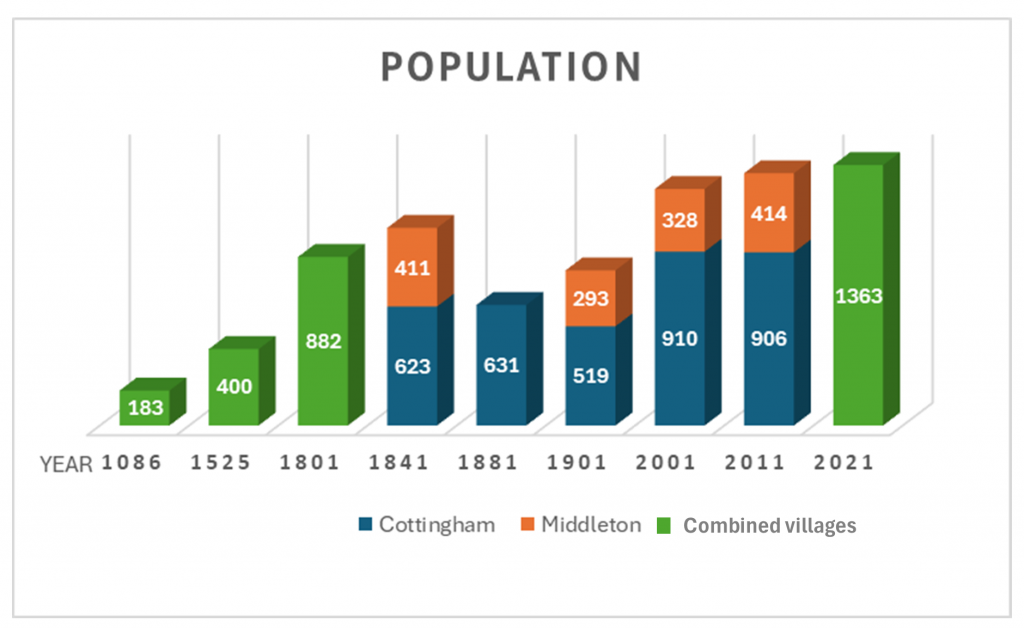
- In the Domesday Book (1086), Cottingham was 840 acres in size. By the mid 1800s, this had almost quadrupled to 3,280 acres – 1,723 for Cottingham and 1,557 for Middleton. Over the same period, the population of the two villages grew from 183 to 1,034. In 2021, the population was 1,363.
A step through time
This historical timeline gives an overview of the villages’ origins and how land ownership has changed over the years. Much of the information on this timeline has been taken from ‘Our Heritage’ by MP York, which you can find on our documents page.